Representing Race Racisms Ethnicity and the Media Review
What's the difference between race and ethnicity?

Race and ethnicity are terms that are sometimes used sloppily, well-nigh interchangeably. But race and ethnicity are not the same thing.
Both terms are used to describe human identity, but in unlike – if related – means. Identity might bring to listen questions of peel colour, nationality, linguistic communication, organized religion, cultural traditions or family beginnings. Both race and ethnicity encompass many of these descriptors. "'Race' and 'ethnicity' have been and continue to be used as ways to draw human diversity," said Nina Jablonski, an anthropologist and paleobiologist at The Pennsylvania State University, who is known for her research into the evolution of human peel colour. "Race is understood by nigh people as a mixture of physical, behavioral and cultural attributes. Ethnicity recognizes differences betwixt people mostly on the basis of linguistic communication and shared culture."
Related: Why did some people become white?
In other words, race is ofttimes perceived as something that'south inherent in our biology, and therefore inherited beyond generations. Ethnicity, on the other hand, is typically understood every bit something nosotros acquire, or self-ascribe, based on factors like where nosotros live or the culture we share with others.
Merely but as soon as we've outlined these definitions, we're going to dismantle the very foundations on which they're congenital. That's considering the question of race versus ethnicity actually exposes major and persistent flaws in how we ascertain these two traits, flaws that — especially when it comes to race — have given them an outsized social bear upon on human history.
What is race?
The idea of "race" originated from anthropologists and philosophers in the 18th century, who used geographical location and phenotypic traits like skin color to place people into unlike racial groupings, according to Britannica. That not only cemented the notion that there are separate racial "types" but also fueled the idea that these differences had a biological ground.
That flawed principle laid the groundwork for the belief that some races were superior to others — which white Europeans used to justify the slave merchandise and colonialism, entrenching global ability imbalances, as reported by University of Greatcoat Town emeritus professor Tim Crowe at The Conversation. "We can't sympathize race and racism exterior of the context of history, and more chiefly economics. Because the driver of the triangular merchandise [which included slavery] was capitalism, and the aggregating of wealth," said Jayne O. Ifekwunigwe, a medical anthropologist at the Center on Genomics, Race, Identity, Difference (Filigree) at the Social Science Inquiry Institute (SSRI), Knuckles University. She is also the associate managing director of engagement for the Eye on Truth, Racial Healing & Transformation (TRHT) at Duke. The center is part of a motion beyond the United States whose members lead events and discussions with the public to challenge historic and present-twenty-four hours racism.

The effects of this history prevail today — even in current definitions of race, where in that location's still an underlying assumption that traits similar skin color or hair texture have biological, genetic underpinnings that are completely unique to unlike racial groups, according to Stanford. All the same, the scientific footing for that premise simply isn't there.
"If you have a group of 1,000 people from the recognized 'races' of modern people, you will observe a lot of variation inside each group," Jablonski told Alive Science. Merely, she explained, "the corporeality of genetic variation within whatever of these groups is greater than the average difference between any ii [racial] groups." What'due south more, "there are no genes that are unique to any detail 'race,'" she said.
Related: What are genes?
In other words, if you compare the genomes of people from dissimilar parts of the world, there are no genetic variants that occur in all members of 1 racial group merely not in another. This determination has been reached in many different studies. Europeans and Asians, for example, share near the same set of genetic variations. As Jablonski described before, the racial groupings nosotros have invented are actually genetically more similar to each other than they are different — meaning in that location's no manner to definitively divide people into races according to their biology.
Jablonski'southward own work on skin color, published in the periodical Proceedings of the National University of Sciences in 2010, demonstrates this. "Our research has revealed that the aforementioned or similar skin colors — both lite and dark — accept evolved multiple times under similar solar weather condition in our history," she said. "A classification of people based on pare color would yield an interesting grouping of people based on the exposure of their ancestors to similar levels of solar radiation. In other words, it would exist nonsense." What she ways is that as a tool for putting people into singled-out racial categories, pare color — which evolved forth a spectrum — encompasses so much variation within different skin color "groupings" that information technology'southward basically useless, she said during a TED Talk in 2009.
We do routinely identify each other'southward race equally "Blackness," "white" or "Asian," based on visual cues. But crucially, those are values that humans have chosen to ascribe to each other or themselves. The problem occurs when nosotros conflate this social addiction with scientific truth — considering there is nothing in individuals' genomes that could exist used to separate them along such clear racial lines.
In short, variations in human appearance don't equate to genetic difference. "Races were created by naturalists and philosophers of the 18th century. They are non naturally occurring groups," Jablonski emphasized.
What is ethnicity?
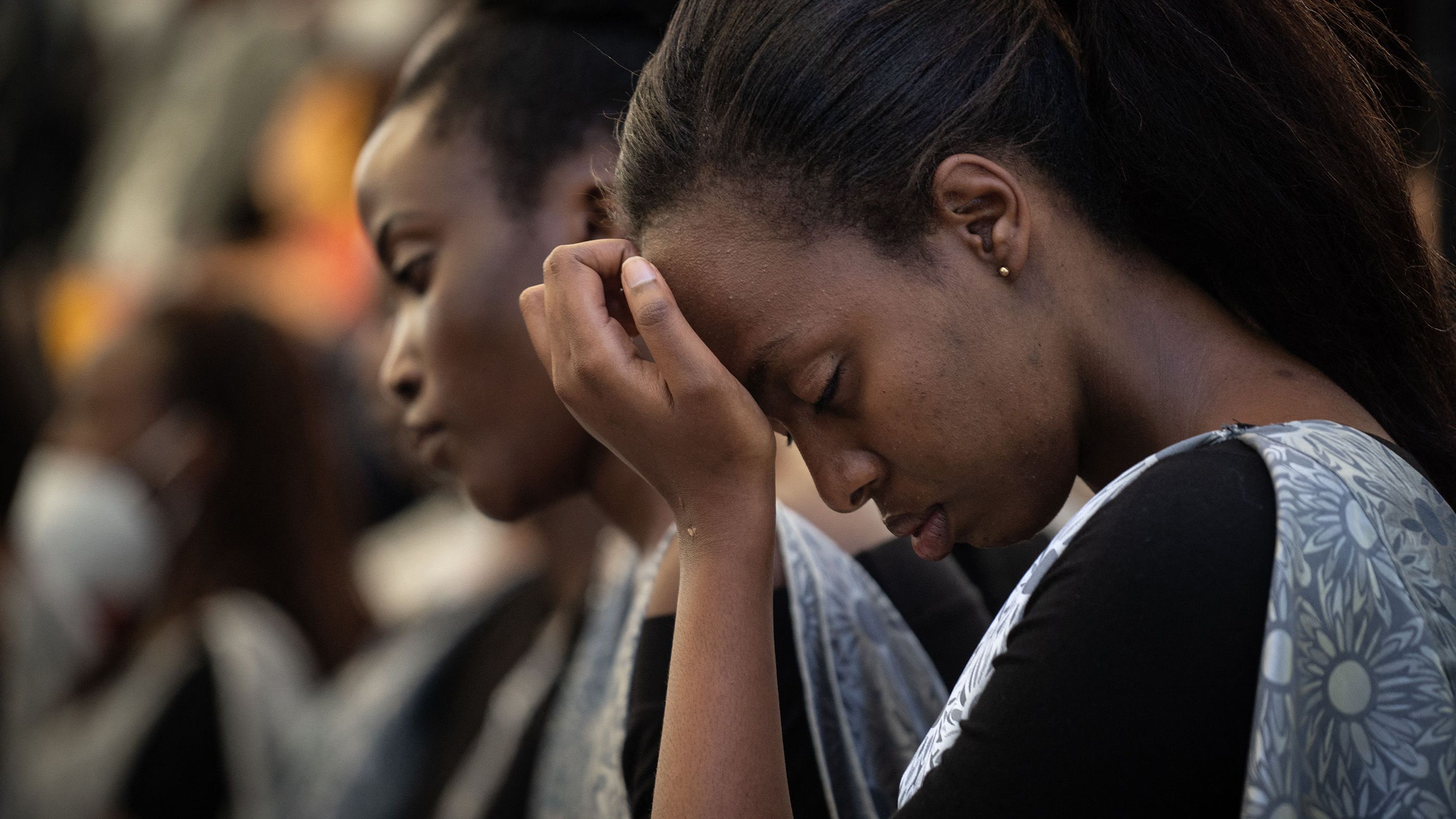
This likewise exposes the major distinction betwixt race and ethnicity: While race is ascribed to individuals on the basis of physical traits, ethnicity is more frequently called past the individual. And, because it encompasses everything from language, to nationality, culture and religion, it can enable people to take on several identities. Someone might choose to identify themselves as Asian American, British Somali or an Ashkenazi Jew, for example, cartoon on different aspects of their ascribed racial identity, culture, ancestry and religion.
Ethnicity has been used to oppress dissimilar groups, every bit occurred during the Holocaust, or within interethnic disharmonize of the Rwandan genocide, where ethnicity was used to justify mass killings. Nevertheless, ethnicity can also exist a boon for people who feel like they're siloed into i racial grouping or another, because it offers a degree of agency, Ifekwunigwe said. "That'due south where this ethnicity question becomes actually interesting, considering it does provide people with access to multiplicity," she said. (That said, those multiple identities tin too be difficult for people to merits, such every bit in the case of multiraciality, which is often non officially recognized.)
Ethnicity and race are too irrevocably intertwined — not but because someone'south ascribed race can be office of their chosen ethnicity only likewise because of other social factors. "If you lot take a minority position [in club], more often than not, you're racialized before you're allowed admission to your ethnic identity," Ifekwunigwe said. "That'south what happens when a lot of African immigrants come to the United States and of a sudden realize that while in their home countries, they were Senegalese or Kenyan or Nigerian, they come up to the U.Southward. — and they're Black." Even with a chosen ethnicity, "race is ever lurking in the background," she said.
These kinds of problems explain why there's a growing push to recognize race, like ethnicity, equally a cultural and social construct, co-ordinate to the RACE Projection.
However in reality, it'south non quite then simple.
Impact of race and ethnicity
Race and ethnicity may be largely abstruse concepts, only that doesn't override their very genuine, real-world influence. These constructs wield "immense power in terms of how societies work," said Ifekwunigwe. Defining people by race, especially, is ingrained in the manner that societies are structured, how they function and how they empathize their citizens: Consider the fact that the U.S. Demography Bureau officially recognizes five distinct racial groups, according to the U.South. Census Bureau.
The legacy of racial categories has also shaped guild in means that have resulted in vastly different socioeconomic realities for different groups. That'southward reflected, for instance, in higher levels of poverty for minority groups, poorer admission to education and health care, and greater exposure to criminal offence, environmental injustices and other social ills. What's more, race is still used past some every bit the motivation for continued discrimination against other groups that are deemed to be "inferior," the Southern Poverty Law Middle explained.
"It's not just that we have synthetic these [racial] categories; nosotros have synthetic these categories hierarchically," Ifekwunigwe said. "Understanding that race is a social construct is simply the starting time. Information technology continues to determine people's admission to opportunity, privilege and also livelihood in many instances, if we look at wellness outcomes," she said. One tangible instance of health disparity comes from the United States, where information shows that African American women are more than twice as probable to die in childbirth compared with white women, the Census Bureau reported.
Perceptions of race even inform the style we construct our own identities — though this isn't ever a negative affair. A sense of racial identity in minority groups tin foster pride, mutual back up and awareness. Fifty-fifty politically, using race to gauge levels of inequality across a population can be informative, helping to determine which groups need more support, because of the socioeconomic situation they're in. As the U.S. Census Bureau website explains, having data about people's self-reported race "is disquisitional in making policy decisions, particularly for ceremonious rights."
All this paints a complex picture, which might get out the states pondering how nosotros should view the idea of race and ethnicity. There are no easy answers, but one thing is clear: While both are portrayed every bit a way to understand human being multifariousness, in reality they also wield ability as agents of partition that don't reflect any scientific truths.
Scientific discipline does show us that across all the categories that humans construct for ourselves, we share more in common than we don't. The real challenge for the future will be to see that instead of our "differences" lone.
Additional resources
For a deeper understanding of how the U.Due south. regime categorizes race and ethnicity, read "Inquiry to Meliorate Information on Race and Ethnicity," which traces how the Census bureau is working to go on up with individuals' understanding of their own identities. (Hint: It's usually complex.) The nonpartisan Pew Research Center has a landing page for its research and survey data related to race and ethnicity, which touches on topics as diverse as clearing, wellness, and educational activity.
As is easy to imagine for such a hot topic, mountains of books have been written almost issues around race and ethnicity. "Superior: The Return of Race Science" (Beacon Press, 2019) by Angela Saini Buoy tracks the history of scientific racism and the ways discredited ideas all the same influence scientific fields today. "Genetics and the Unsettled Past: The Standoff Between DNA, Race, and History" (Rutgers University Printing, 2013), is a scholarly look at how the field of genetics has complicated how we talk well-nigh genetics and history. Isabel Wilkerson'due south "Caste: The Origins of our Discontents" (Random Business firm, 2020) explores how race and ethnicity are used to divide people into hierarchies.
Bibliography
Bibliography
"About the topic of race." U.South. Census Bureau. Dec. 3, 2021.
"Racism and Health." Centers for Disease Control and Prevention. November 24, 2021.
"What Racism Costs Us All." Finance & Development, International Monetary Fund. Autumn 2020.
(2014, July 31). A New African American Identity: The Harlem Renaissance. Smithsonian. https://nmaahc.si.edu/explore/stories/new-african-american-identity-harlem-renaissance
Roberts, Frank Leon. (2018, July 13). How Black Lives Matter Changed the Way Americans Fight for Freedom. ACLU. https://www.aclu.org/web log/racial-justice/race-and-criminal-justice/how-black-lives-matter-changed-fashion-americans-fight
White Nationalist. Southern Poverty Law Center. https://world wide web.splcenter.org/fighting-hate/extremist-files/ideology/white-nationalist
Newkirk II, Vann R. (2018, Feb. 28). Trump's EPA Concludes Environmental Racism Is Real. The Atlantic. https://www.theatlantic.com/politics/archive/2018/02/the-trump-administration-finds-that-environmental-racism-is-existent/554315/
American Psychological Association. Ethnic and Racial Minorities & Socioeconomic Status. https://world wide web.apa.org/pi/ses/resources/publications/minorities
(2019, June ten). Ethnic Cleansing. The History Channel. https://www.history.com/topics/holocaust/ethnic-cleansing
Smedley, Audrey, The history of the idea of race. Britannica. Accessed April 9, 2022. https://www.britannica.com/topic/race-human being/Scientific-classifications-of-race
Jablonski, Nina and Chaplin, George. (2010, May v). Man skin pigmentation as an accommodation to UV radiations. PNAS. https://world wide web.pnas.org/doi/10.1073/pnas.0914628107
Originally published on Live Science on Feb. 8, 2020 and updated on Apr 9, 2022.
Source: https://www.livescience.com/difference-between-race-ethnicity.html
0 Response to "Representing Race Racisms Ethnicity and the Media Review"
Post a Comment